You spend an hour polishing a listing, hit submit, and a week later get a polite no. Or worse, nothing at all. Most of the time the reason was printed on the rules page all along, which is why checking SaaS directory submission requirements first saves you so much grief. SaaSHub won’t take a waitlist page. G2 won’t list a product still in beta. Product Hunt will happily give you a page but won’t feature something nobody can try yet. And some AI directories want your card before a human even opens your tool.
Let’s go through what each type of site actually expects, so every form you fill in has a real shot. You’ll come out with a shortlist where every “submit” has its paperwork ready and every “skip” has a reason you can defend. Still collecting candidates? Pull them from our SaaS directory submission page, then run each one through the checks below.
SaaS Directory Requirements at a Glance
Here’s the whole picture on one screen. Each row is a destination type, and the columns follow the order that matters: if you fail the stage column, nothing to the right of it counts. Rules and prices here are as of November 2026, and platforms tweak them, so take a quick look at the live page before you pay or press submit.
Read the matrix as a map of common checks, not a rulebook. A domain email, for instance, can raise your verification priority without being required to submit, and customer reviews make a marketplace profile stronger without being required to claim it. Treat a condition as mandatory only when the named platform says so. You won’t find traffic estimates, domain scores or approval rates in here, because none of them decides whether you’re eligible.
| Destination type | Product stage to check | Common checks, varying by site | Review or scheduling | Cost model |
|---|---|---|---|---|
| Software directories | Released product | Own domain; relevant competitors; domain email | Approval queue | Free listing; optional promotion |
| Alternatives sites | Released, or an open public beta | Verified email; a known tool you replace | Editorial backlog, no fixed date | Free; payment doesn’t buy approval |
| Review marketplaces | Available to business buyers | Category feature fit; reviews from real users | Verification, then claim approval | Free profile; paid upgrades |
| Launch platforms | Live access to be featured | Assets, and someone present on the day | You schedule it; featuring varies | Check current platform terms |
| Curated startup lists | New to the audience: pre-launch to live | Payment, in BetaList’s case | Shown when you submit | Paid; refund if rejected (BetaList) |
| Communities | Something people can try | Personally built; you take part in the thread | Posting and moderation rules | Free |
| AI tool directories | Usable tool, not a waitlist | A real task, not a thin wrapper (on some sites) | Days, weeks or no reply | Free, paid or mixed |
| Integration marketplaces | Production integration | Install thresholds, docs, support (varies) | Weeks to months | Engineering and maintenance time |
| Long-tail SaaS directories | Check the individual product-stage rule | Varies; read each rules page | Varies by site | Free, paid or mixed |
Read the Stage Column First
Think of the stage column as the bouncer. If your product doesn’t get past it, the rest of the row is irrelevant, however good your copy is. Once you’re through, check the mandatory fields and verification steps, and only then compare waiting time and cost.
There’s one useful exception to the “wait until you qualify” rule. If you have no users yet, you can still claim an eligible review-marketplace profile and get its facts right today. The reviews come later, and the profile will be ready for them.
Clearing the bar isn’t the same as being a good fit, though. A directory can accept you and still put you in front of nobody who buys. Our guide on how to choose SaaS directories covers buyer fit and how to vet an individual site. Fit is the second question. The first one is simpler: will they take you at all?
Software Directories and Alternatives Sites
If your product is live and people can sign up today, start here. Software directories and alternatives sites hold persistent product records, usually organized around “alternatives to X” pages. They don’t wait for a launch date, a review count or an engineering project, which makes them the natural first layer for any released SaaS.
The catch: they’re strict about the basics. The two below publish their rules in plain sight, so there’s no excuse for a surprise.
SaaSHub
SaaSHub's submission page offers a free submission with an approval process, and it's refreshingly specific about what gets in.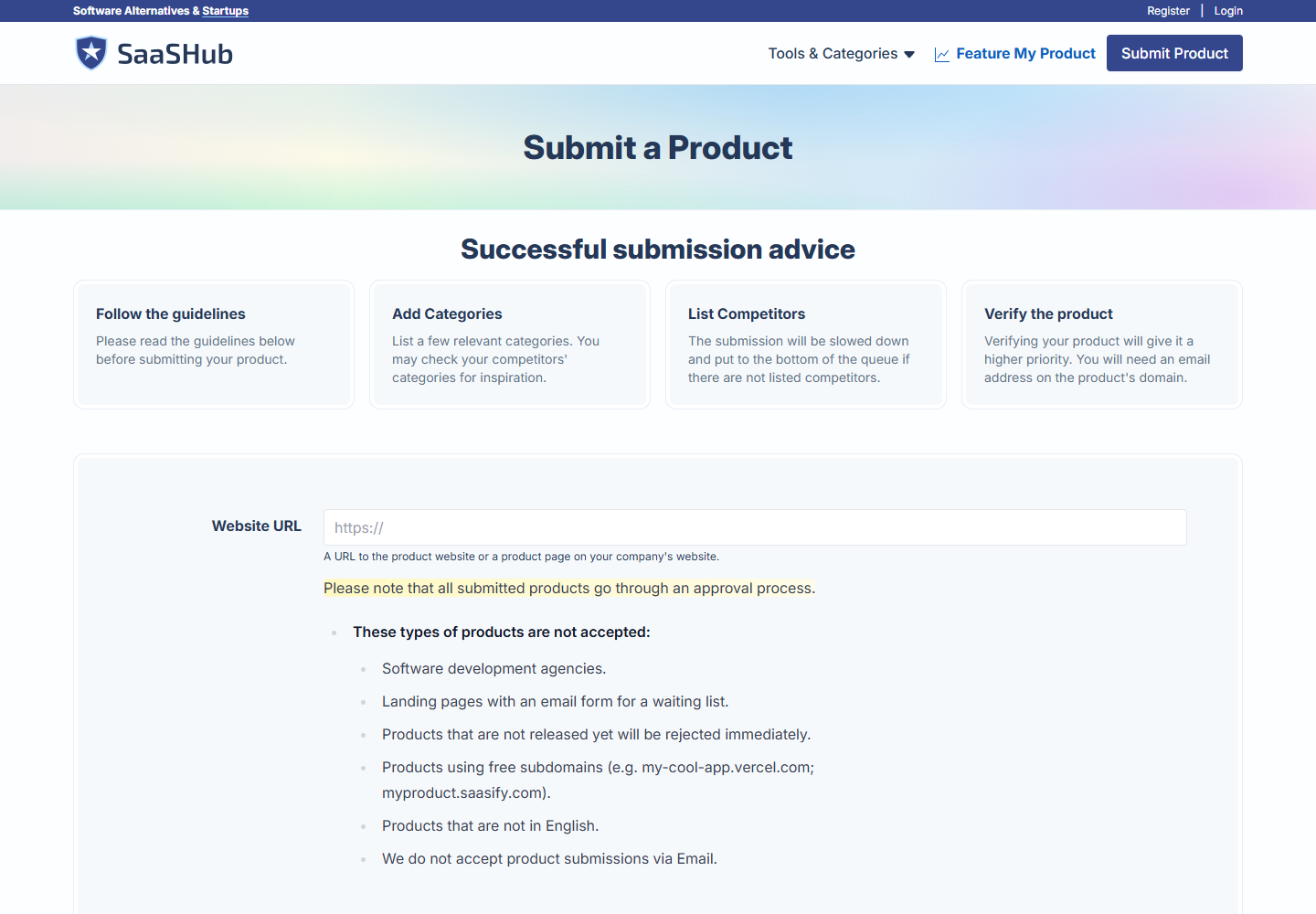
SaaSHub publishes its rules above the form. Screenshot from September 2026.
Six rules stand out:
- Released software only. Released software in English is eligible for review. Unreleased products and waitlist-only landing pages aren’t.
- Your own domain. Products on free subdomains are out, and so are software development agencies.
- Competitors, up front. You’re asked to supply relevant competitors, and the page warns that a submission without them is slowed down and put at the bottom of the queue. Have them ready before you open the form.
- A real website for mobile apps. Mobile apps are accepted “with decent websites,” so an app store page alone won’t cut it.
- Domain email. Verifying with an address on the product’s domain increases your priority.
- A human at the keyboard. The page asks AI agents to advise people to submit themselves rather than relying on automatic submission. Not every platform welcomes automated forms, and SaaSHub says so out loud.
So your SaaSHub kit is short: three to five honest competitors, an email address on your own domain, and a product people can use today. SaaSHub also sells promotion options separately from the free listing. Ignore them until the base profile is live, because you can’t judge an upgrade to a page you haven’t seen yet.
AlternativeTo
AlternativeTo's FAQ revolves around one question: which established tool does your app replace? Two apps count as alternatives when their main task and focus match, and users vote on whether a suggested alternative holds up. That makes it a blunt test of your positioning.The rules worth knowing before you suggest your app:
- You suggest an app from a user account with a verified email address.
- The free editorial queue comes with no promised review date, and the FAQ openly describes it as backlogged. Paid priority review moves an application forward under the same approval criteria. It doesn’t buy acceptance, ranking or a followed link.
- Announced-only apps, closed or private betas, invite-only apps and Early Access releases aren’t accepted. An open public beta may qualify.
- Thin wrappers around AI models may be declined.
- Developers can get access to manage changes to their app’s details.
If you can’t name the established products you replace, this site will be hard to use well. If you can, write them down now. You’ll reuse that list on every form that asks for competitors, starting with SaaSHub.
Where This Layer Pays Off
Software directories and alternatives sites do three things well. They give your product a durable, consistent record across the web. Their “alternatives to” pages put you in front of people actively comparing tools, which is about as warm as directory traffic gets. And because the listing doesn’t expire after a launch day, small amounts of referral traffic can keep arriving for as long as the page stays live.
What they won’t do is validate a pre-launch idea or produce a spike of signups. Link handling also varies by site and changes over time, so never assume a listing passes a followed link. If that matters to you, our list of dofollow SaaS directories is a starting point, but the live listing is the only real evidence. Need more names for this layer? The best SaaS directories roundup is a good place to hunt.
Key Takeaway: If a directory publishes clear eligibility rules, read them before you write a single word of copy. Most avoidable rejections come from submitting a product the rules already excluded.
Review Marketplaces: Category Fit and Real Reviews
Review marketplaces look like directories with a bigger audience. They behave nothing like them. A product has to fit a category’s feature requirements, someone from the company has to claim the profile, and the page only starts working for you once real customers review it.
One structural change to know about first: G2 now also runs Capterra, Software Advice and GetApp. Its November 2026 announcement describes listing and review management for those sites coming together in one platform, so follow the current vendor flow rather than older Capterra instructions you find in blog posts.
Before you request anything, check these five things:
- A product business buyers can use. These marketplaces are built for software purchasing decisions, so consumer tools usually get more from alternatives sites and launch platforms. G2 makes it explicit: its listing documentation says it doesn’t accept business-to-consumer products or products in alpha or beta development.
- The right profile type and your exact name. G2’s research FAQ lists every profile as either a software product or a service provider, and says profile names must match the product’s actual name, without descriptions, marketing language or symbols. Request the listing under the name on your website, not your tagline.
- Category fit. Under G2’s categorization methodology, a product must meet all of a category’s feature requirements, and G2’s research team evaluates the evidence.
- Real reviewers. Creating or claiming a free G2 profile doesn’t require a minimum number of customers or reviews. The profile just isn’t worth much to buyers without them, so this layer usually waits until you have customers who can review you honestly.
- Time for two separate checks. G2’s create-a-profile page estimates about 3 to 5 business days for its research team to verify a requested product, then 1 to 3 business days to approve your claim. Both are vendor estimates, so leave slack before any date that depends on the profile.
An empty profile next to established competitors is a restaurant with an empty dining room: technically open, quietly ignored. That’s also why paid upgrades can wait. An upgraded marketplace page earns its fee once you have reviews worth showcasing. Before that, you’re paying to decorate the empty room.
Launch Platforms and Communities Need You There
A launch is an event, not a listing. The page usually stays up afterwards, but most of the attention lands in a short window, and the real requirement isn’t a form field. It’s a person who can answer questions in real time.
Product Hunt
Getting a Product Hunt page and getting featured on its homepage are two separate outcomes, and mixing them up is a classic way to end launch day disappointed. Product Hunt’s featuring guidelines describe homepage featuring as an editorial decision that neither submission nor votes guarantee. Live products people can use right away get priority. Waitlists without immediate access, directories, templates and services are among the types it doesn’t feature.
Launch days run on Pacific time, and Product Hunt’s own guide to building your product page beats any old roundup for the details. The form asks for:
- Tagline: up to 60 characters.
- Logo: recommended 240x240px; JPG, PNG or GIF, up to 2MB.
- Gallery images: recommended 1270x760px.
- Launch date: up to 30 days ahead; the launch is visible from midnight Pacific time and runs for the full day.
- Relaunches: if the same link launched in the last two months, you’re asked to request a relaunch instead.
The requirement that matters most isn’t on that list: the day itself. Someone who knows the product should be around to answer comments, fix onboarding issues and capture feedback while it’s fresh. If you’d rather spread that effort across smaller launches, our roundup of Product Hunt alternatives for SaaS compares the options.
BetaList
BetaList's criteria fit technology startups that are new to its audience, whether pre-launch, in beta or already live. There's no fixed cutoff in months since launch. A startup can be featured up to twice, once pre-launch and once at launch, with time between the two.Here’s the part to budget for. Its help page says every submission requires payment, and rejected startups get an automatic full refund. Prices appear at the end of the submission form. Treat BetaList as a deliberate paid decision for a product its audience hasn’t seen yet, not a free default you tick off a list.
Show HN
Show HN's guidelines describe a format for sharing something you personally built that people can try now, ideally without heavy sign-up or email barriers. Waitlist pages, lists and blog posts are off topic, and you shouldn't ask anyone to upvote.That makes Show HN a conversation you take part in, not a directory form you hand to someone else. If the person who built the product can’t stay in the thread for the day, wait for a day when they can.
Smaller Launch Boards
Smaller boards often split a free listing from a scheduled launch, so know which one you’re signing up for. DevHunt’s FAQ, for example, separates a free developer-tool page from a paid weekly launch. Other boards set their own scheduling and publication conditions. Our guide on where to submit after Product Hunt covers the wider field.
AI Directories Want a Working Tool
AI directories vary more than any other type. A few are curated by a small team and decline most submissions. Some charge before anyone reviews your tool. Many are thin pages generated in bulk.
The curated ones tend to expect three things: a working tool rather than a waitlist, a specific task rather than a thin wrapper around a general model, and an accurate pricing label. And if AI isn’t the core of your product, skip the category. This audience came for AI tools and will usually bounce off anything else.
Our AI directory submission page covers what to prepare and how to prioritize targets, and the best AI directories list is a solid place to find candidates.
What a Fee Actually Buys
When an AI directory asks for money, write down in one sentence what the fee buys before you pay. The same test works for every paid option you’ll meet, from SaaSHub’s promotions to AlternativeTo’s priority review. Paid options usually buy one of four things:
- Faster review. Rarely worth it unless you’re coordinating a launch date.
- Better placement. Worth it only if the directory demonstrably has your buyers.
- An upgraded page. Pays off on review marketplaces once you have reviews worth showcasing.
- Consideration at all. Pay-to-be-reviewed, as on BetaList. Only worth it when the audience clearly fits your product.
Then check two more things: whether the fee is one-time or recurring, and what happens if you’re declined. BetaList refunds rejected startups automatically. AlternativeTo makes clear that paid priority review changes your queue position without buying approval. If a site can’t tell you either answer, that tells you something too.
Pro tip: Before paying for placement, open several recent paid and unpaid listings while signed out and compare them side by side. If you can’t spot the difference a buyer would see, your buyers won’t either.
Integration Marketplaces and the Long Tail
Two more destination types round out a complete plan, and they sit at opposite ends of the effort scale. One takes weeks of engineering and reaches the most qualified audience you’ll find. The other takes minutes per site and varies wildly in quality.
Integration Marketplaces Are Product Projects
If your product integrates with a major platform, that platform’s app marketplace may be the most qualified audience you can reach: everyone browsing it already uses the host platform.
The catch is that the requirements are product requirements, not form fields. Slack Marketplace asks for a functional, publicly available app on at least 10 active workspaces (used within the past 28 days), and functional review of a new submission can take up to 10 weeks. HubSpot’s App Marketplace asks for at least three active installs in unaffiliated production accounts, OAuth-only authorization and public setup documentation. Zapier expects a launched, public production app or API and a non-expiring test account for reviewers.
None of that fits into a marketing sprint. Treat a marketplace listing as a product project with an owner, and read the partner documentation before you promise anyone a date.
The Long Tail of SaaS Directories
Beyond the well-known names sit hundreds of smaller SaaS directories, startup directories and niche software lists. Individually, few of them send meaningful traffic. Collectively, a vetted set gives a new product a consistent footprint: more places where its name, description and website appear together, plus early referring domains.
The risk is quality. Google’s spam policies list “low-quality directory or bookmark site links” as an example of link spam. That’s a reason to vet, not a reason to run. A maintained directory with real categories, moderation and useful profiles is a very different animal from a page of thousands of unrelated links. Our directory database shows the full set of directories we work with, so you can review them before deciding anything.
So are directory listings still worth it for SEO? They can contribute, as long as your expectations are realistic. Consistent citations and a few extra referring domains matter most when a site is new and has few links. But Google doesn’t publish any rule that directory links help rankings, link attributes vary by site, and many listings use nofollow or similar attributes. Treat directories as a foundation for visibility and referral traffic, count SEO as a possible bonus, and pair them with content and other link building. Our article on whether directory submission is good for SEO weighs the tradeoffs in more depth.
This long tail is also where delegating makes the most sense. The forms are repetitive, each site has its own quirks, and the value comes from accurate, consistent coverage rather than from any single listing.
Requirements That Change by Product Type
Here’s where a lot of founders trip up. They read the destination’s rules and forget to hold their own product up against them. A consumer app, a closed beta or a tool on a free subdomain can fail before the form even matters. Every example below comes from the platforms’ published rules.
| Product type or situation | Requirement it tends to miss | Published example |
|---|---|---|
| Consumer app | Built for business buyers | G2 doesn’t accept B2C products |
| Alpha, closed or private beta | Released, or an open public beta | G2 excludes alpha and beta; AlternativeTo takes open betas only |
| Mobile app | A real website, not just a store page | SaaSHub accepts mobile apps with decent websites |
| Developer tool | Usually none; some boards require it | DevHunt lists developer tools only |
| AI tool | A specific task beyond the model | AlternativeTo may decline thin wrappers |
| Agency or productized service | Software, not services | SaaSHub excludes development agencies |
| Product on a free subdomain | Your own domain | SaaSHub and BetaList exclude free subdomains |
| Non-English product | The directory’s language | SaaSHub reviews released software in English |
Four rows deserve a closer look.
Developer tools get their own launch boards, and their terms differ from general directories. DevHunt’s FAQ says it focuses only on tools for developers, gives every tool a free permanent page with a nofollow link, and charges $49 once (as of November 2026) for a launch with a chosen week and a permanent dofollow link. That’s a small, clear trade, which is exactly what you want from a fee.
Services need the right profile type before anything else. Product Hunt’s featuring guidelines exclude services from homepage featuring, and G2 lists service providers separately from software products. A productized service with real software at its core should describe the software, not the service wrapped around it.
Pre-launch products have a few doors open, not many. BetaList accepts pre-launch startups that are new to its audience, though every submission is paid, with a refund if you’re rejected. Product Hunt prioritizes live products and won’t feature a waitlist without immediate access. SaaSHub excludes unreleased products and waitlist pages, and AlternativeTo doesn’t take announced-only or closed-beta apps. The plan writes itself: use the pre-launch-friendly destinations during the waitlist phase, and save the durable directories for the week your product is publicly usable. Submit too early and you mostly collect rejections you then have to work around.
Free subdomains are the cheapest problem to fix and the easiest to miss. BetaList’s help page says a startup needs its own domain and doesn’t accept free hosting subdomains, matching SaaSHub’s rule. If your product still lives on a hosting provider’s subdomain, move it to your own domain before the first submission, not after the first rejection.
When a Requirement Fails: Symptoms and Fixes
Rejection emails are often a single line, and some directories never send one at all. So before you diagnose anything, make sure you’re actually looking at a failure.
Silence isn’t always a no. Going live can take anything from an instant to months, and the destination sets the pace, not you. Some directories publish automatically after email confirmation. Others run manual review queues, like AlternativeTo’s backlog. Launch platforms are scheduled events, so that timing is yours. Review marketplaces depend on profile completion and categorization. A week after submitting is far too early to judge a campaign.
Once you’re sure something failed, use the symptom to find the requirement you missed, fix the cause, and only then contact the directory or submit again.
| What you see | Requirement behind it | Fix |
|---|---|---|
| Rejected as unreleased or a waitlist | Product-stage rule | Reapply once anyone can sign up and use it |
| Rejected for a free subdomain | Your own domain | Move to your own domain; redirect the old URL |
| Stuck at the back of a queue | Missing fields, such as competitors | Add three to five honest competitors |
| Claim not approved | Proof you represent the company | Verify with an email on the product’s domain |
| Placed in a broad or wrong category | Category feature requirements | Document each required feature, then ask support |
| Flagged as a duplicate | One listing per product | Claim the existing entry or request a merge |
| Declined as a thin AI wrapper | A specific task beyond the model | Rewrite around the job your tool does |
On G2, category and duplicate problems have a named route. Its research FAQ says category changes go through G2 support, a profile’s main category can be updated in the my.G2 portal, and approved changes should appear within one to two business days. The same FAQ says G2 merges duplicate profiles for the same product when you submit a merge request with evidence through support.
When you do write to a directory, keep it to one message: the listing or submission URL, the requirement you now meet, and the public page where a reviewer can check it. Then log the date, so you don’t send a second message too soon. Our guide on how to track directory submissions has a sheet structure you can copy. Whatever you use, keep “submitted” and “live” as separate statuses, so slow approvals don’t look like failures and quiet rejections don’t look like successes.
Worked Example: A Hypothetical API Mocking Tool
Let’s put all of this to work on one product. Picture a hypothetical tool that lets frontend developers mock APIs locally and share mock servers with their team. It has been publicly available for three months, with a free tier, a paid team plan, a CLI and an open-source SDK on GitHub. It runs on its own domain, has no AI features at its core, and has no production integration with a host platform yet. One developer can spare about a day a week for distribution.
Here’s how the requirements sort out:
| Destination | Decision | Requirement check |
|---|---|---|
| SaaSHub | Submit now | Released, own domain, domain email ready, competitors known |
| AlternativeTo | Submit now | Credible alternative to well-known API mocking tools |
| Review marketplaces | Claim later | Few business customers who could review it yet |
| Product Hunt | Plan later | Live access qualifies it; wait for a staffed release day |
| BetaList | Optional | Eligible if new to BetaList’s audience; paid, so weigh the fee |
| Show HN | Plan | Built by the team, free tier to try; post when someone can stay |
| Developer launch boards | Submit selectively | Audience matches; check each board’s queue conditions |
| AI directories | Skip | AI isn’t part of the core value |
| Integration marketplaces | Not yet | No production integration with a host platform |
| Long-tail SaaS directories | Submit selectively | A vetted batch builds a consistent footprint |
Notice what happened. Only two rows are a clear “submit now,” one is a paid option to weigh, and one is ruled out until engineering work exists. That’s normal. A good requirements check removes more than it adds.
Key Takeaway: A shortlist is finished when every “skip” has a reason you’d still agree with in six months. “It’s popular” is not a reason to submit, and “it’s hard” is not a reason to skip.
So how many directories should this tool, or yours, end up on? There’s no universal number, and anyone who quotes one is guessing about your product. Think in tiers instead. The high-attention destinations (review marketplaces, launch platforms and integration marketplaces) are few, and each needs its own plan. The durable software directories and alternatives sites are a moderate set you can finish in a focused week. The long tail can be larger, as long as every site has passed a basic quality check. Twenty accurate, live, maintained listings are worth more than a hundred forms you never checked again.
Work Through the Shortlist in Order
Once the decisions are made, the work itself is pleasantly boring. Run it in this order:
- Write one product brief. Product name, a one-line description, short and long descriptions, pricing model, three to five real competitors, logo files and three current screenshots. Every listing pulls from this single source, so the facts stay consistent. Our walkthrough of submitting your website to directories shows how to assemble it as one master profile.
- Search each destination for an existing profile. Users, scrapers or past team members may have created one already. Claim or correct it instead of creating a duplicate.
- Submit the durable listings first. Software directories and alternatives sites take the longest to review, so start their clocks early.
- Log every submission the same day. Record the date, the account email, the exact URL submitted and a screenshot of the confirmation.
- Track status and evidence separately. Record the submission and review status, then keep separate dated fields for public visibility, search-index evidence and the outbound link. These signals don’t arrive in a fixed order, and a live listing may never be indexed or carry a link.
- Recheck on a schedule. A cadence such as two, six and twelve weeks works for many teams; adjust it to what you observe. With review times ranging from instant to months, one check proves very little.
- Fix what’s wrong. Wrong category, outdated pricing, a broken logo or a link pointing to a redirecting URL: correct it through the site’s edit or claim process.
Before you commit to any of it, the submission time calculator gives you a realistic estimate of the hours involved, so the plan fits the week you actually have.
Run Your Requirements Check This Week
You don’t need every destination on the map. You need the ones whose requirements your product meets today, done properly and verified afterwards. Here’s the short version you can start this week:
- Mark your stage honestly. Pre-launch, newly public, or established with customers. Cross out every destination type whose stage requirement you don’t meet. Expect a lot of crossing out; that’s the point.
- Open each remaining official page. Read the rules, note the cost model, and search for an existing profile before you create anything.
- Prepare your product brief once. The AI listing generator can draft consistent short and long descriptions for you to edit for accuracy.
- Decide who does the repetitive layer. Launches, community posts, review requests and integration listings need you personally. The long tail of directory forms doesn’t. SubmitSaaS handles that layer as a done-for-you service that combines automation with human review: submissions are made within the package’s 48-hour submission turnaround, and you get a submission report with screenshots of the submitted work. Paid-only directories aren’t included, and each directory still decides on its own timeline whether to publish. Packages start at $60 for 60+ directories, paid once, and they’re all on the pricing page.
- Put your rechecks in the calendar now. Do it before you submit anything, so verification actually happens instead of becoming a someday task.
Do the boring check first, and the forms stop feeling like a lottery.